
The short answer
The best AI-driven UGC video platforms for startups depend on the first ad's bottleneck: Wizstar for a product-led shot plan, Arcads for scripted actor performance, Creatify for a product-link draft, or HeyGen for a consistent presenter. None is a proven winner for conversion or cost. This public-documentation comparison was checked October 27, 2026; it is not a hands-on test.
What Should a Startup Get From an AI UGC Video Platform?
A first-time buyer needs a vertical ad whose product, claim, captions, and closing action survive human review. AI UGC describes a style; It is not footage of a customer who used the product. The FTC's guidance on consumer testimonials says AI stock avatars are not categorically forbidden, but a fake or misleading claim of customer experience can be a problem.
Buy for the bottleneck in the first brief: shot planning when the image is strong, performance when the script is approved, link-based drafting when the product page is reliable, or a stable avatar when the founder's explanation must be repeated. Each path leaves a different review burden.
How Were These Four Platforms Shortlisted?
The four represent distinct routes from an approved product brief to a paid-ad candidate. Documentation can identify inputs, editing routes, and billing rules; It can not predict the output for a specific product. That is a more useful procurement lens for startup AI UGC ad platforms than actor-library counts. This is a trial design, not reported test results.

Use One Product, One Claim, and One Vertical Ad Brief
Use one authorized photo and product page for an illustrative 600 mL bottle. Confirm the claim “600 mL capacity” against the real SKU before testing. Supply the approved logo and pack image. Request a 20-second, 9:16 ad: show the bottle early, state the verified capacity, include a clear product view, and close with a neutral shop prompt. A synthetic presenter must not invent personal use.
Hold the brief constant despite different entry points: use the approved URL where supported, the same written facts elsewhere, and the same image where possible. Log manual setup. Inspect bottle shape, logo, capacity text, spoken and on-screen claims, and the closing frame. These are proposed checks, not observations of generated outputs. A result that needs a new product photograph, a rewritten claim, or a separate editor should still be logged; otherwise the apparent convenience of the platform is overstated.
Compare Review Work and Cost per Approved Ad
Record concept approval, first render, and revisions separately. The next edit is part of the cost. Track credits or generation spend, edit time, and rights or asset work, then divide by approved ads. Without a matched trial, that denominator is unknown.
To compare pricing for UGC video production tools, use the same billing period and the configuration the brief requires. Annual discounts, model, resolution, avatar, and revision rules distort “per video” prices. Save checkout terms and pre-render estimates. Ask whether a custom template means a reusable brand layout, preset format, or editable workflow. The practical comparison sheet should include the first approved script, number of rendered attempts, final file dimensions, time spent fixing copy and captions, and the rights decision that permitted publication.

Wizstar — Product-Led Ad Briefs
Wizstar's AI Video Agent says it can start with a product, brief, script, or reference image, plan scenes, and refine shots. It fits a team turning a product still into an opening view, factual middle beat, and closing frame. The page does not establish that a generated bottle label will stay accurate.
Best Fit and Key Trade-Offs
Best fit: a team whose ad needs visible product shots rather than sustained actor delivery. Review each product frame and determine whether a weak shot can be revised without rebuilding the edit. I would check the label before the lighting: camera motion cannot rescue a changed capacity marking. On the checked date, the public Starter price was $16 per month equivalent, billed $192 yearly; watermark-free export and commercial use are listed, the latter subject to terms. Generation cost varies by model and settings, and custom voice or avatar is a paid add-on. Ask for the credit estimate at the chosen resolution. A mainly face-to-camera script may not need shot planning.

Arcads — Actor-Led Ad Variants
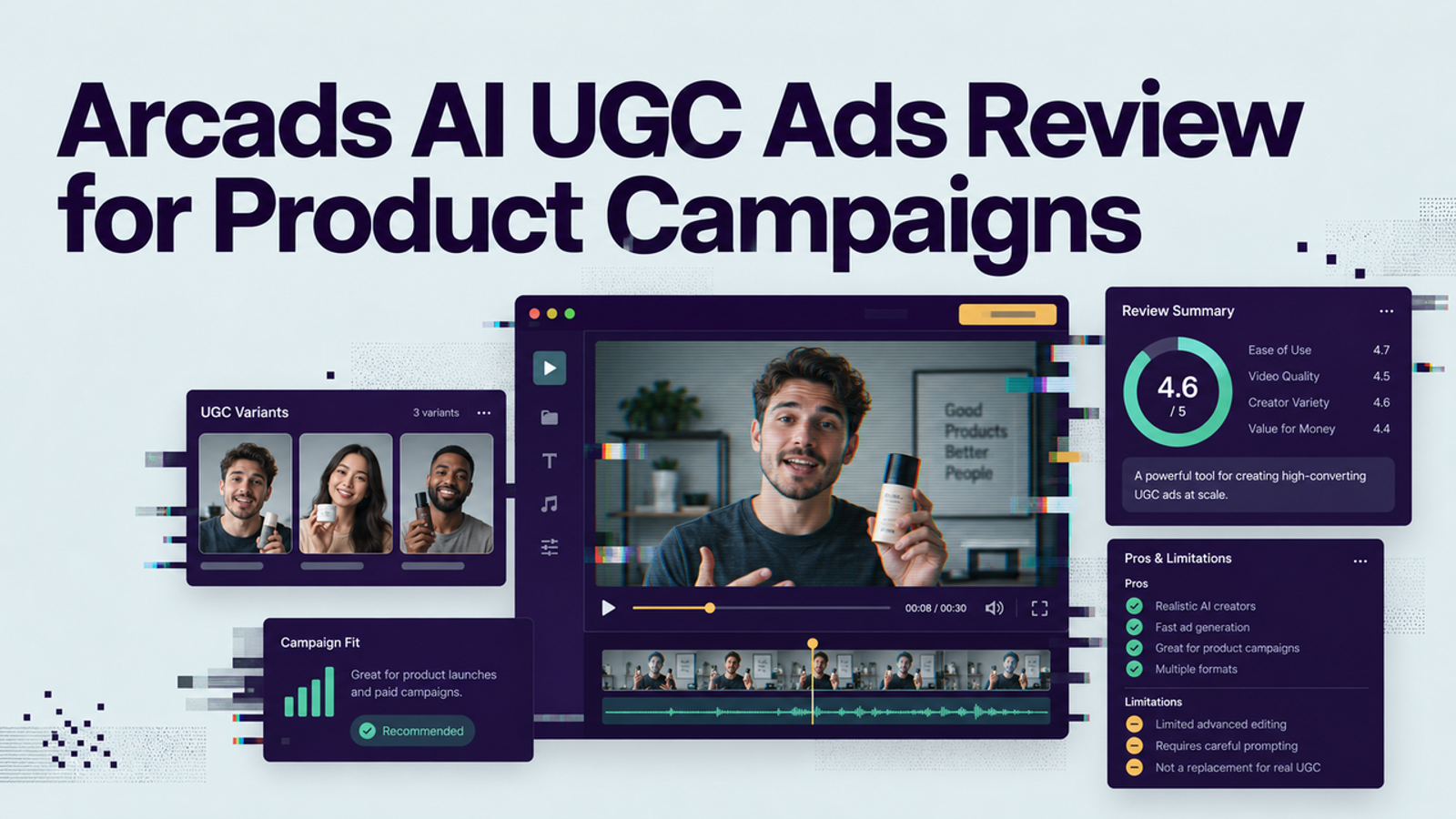
Arcads documents UGC-style ads with AI actors, captions, and product shots. It suits a startup with an approved line that needs presenter variations. Keep the bottle script fixed while changing the actor, so script and casting effects do not blur together.
Best Fit and Key Trade-Offs
Best fit: a script-ready team testing speaker-led concepts with a real product still available. Check for implied personal use, inaccurate product views, and caption drift. Arcads describes a monthly credit pool and a pre-generation cost display; dollar prices are inside the app, and some workflow and team features require higher plans. Record the cost of recasting and correcting one line, rather than assuming every generated take is usable. The current Arcads terms list distribution rights but call the output license personal and non-transferable, with limited permitted external edits. Agency handoff or major postproduction needs clarification. It cannot supply a defensible claim or a real customer's experience.

Creatify — Product-Link Ad Workflows
Creatify fits when the approved product page is the source of truth. Its Ad Agent documentation describes starting from a URL or uploads, reviewing a concept and script before rendering, and revising through chat or time-stamped comments. That lets the team reject a mistaken claim before rendering.
Best Fit and Key Trade-Offs
Best fit: a store team with clean product data and a human script checkpoint. The official Creatify pricing page lists AdFlow templates on Standard and Ad Agent on Pro, so check the tier needed for the intended route. The displayed Pro rate was $38 per month equivalent with annual billing, versus $55 monthly on the checked date. Template counts do not show whether typography and offer blocks remain reusable; try a second approved script in the same layout. Ad Agent cost varies by request, so plan credits are not an approved-ad price. Log revision costs. Check imported facts against the specification sheet: a stale page can import the wrong size, offer, or image.

HeyGen — Avatar-Led Explainers
HeyGen's UGC video ads page describes script-led avatar videos. It suits a founder with an approved explanation who wants one presenter across versions. The team still supplies the reasoning and product proof; a consistent face verifies neither.
Best Fit and Key Trade-Offs
Best fit: repeatable delivery by an authorized founder or spokesperson. Review voice, mouth timing, captions, and the cut to the product still. HeyGen's Creator tier was listed at $29 monthly on the checked date, with 1080p export and branding removal; its Free-plan terms explicitly exclude advertising. A custom likeness needs the subject's consent. Retain the approved script so later versions do not quietly change the claim, and price the actual avatar and revision path because premium modes consume credits differently. For tactile product handling, filmed footage may be the better input.
Which Platform Should a Small Team Trial First?
Trial the platform that removes the biggest obstacle to an approved ad: Wizstar for product sequencing, Arcads for actor delivery, Creatify for a fact-checked link draft, HeyGen for an authorized spokesperson. These routes work; it does not rank quality. For best UGC video creation tools with custom templates, test whether the approved layout and end card can be reused without retaining an old claim.
Give reviewers the specification sheet and export requirements. Record approve, fix, or reject with a reason tied to a frame, line, or right. Before I call it ad-ready, I want to know what happens on mobile: is the bottle recognizable, and is capacity legible at the actual crop? Buy against that evidence, not the count of drafts.
When Is Real Creator Footage the Better Starting Point?
Use filmed creator footage when persuasion depends on actual customer experience, tactile demonstration, or a product detail that must remain exact in every frame. A generated actor cannot acquire experience by reading a script. Keep permissions and factual support with the real footage; AI can still help plan or edit it.

Conclusion
The first AI UGC purchase should be decided with one authorized product, one provable claim, and one placement brief. Compare the four workflows by what survives review, what must be redone, and what the team is actually licensed to publish. The information here is general, not legal advice; rights, licenses, and ad policies must be checked against the current provider terms, agreements, and applicable platform rules before publication.
FAQ
- Can a startup use an AI UGC-style clip as a customer testimonial?
- Only if the underlying testimonial is genuine and the presentation is not misleading. An actor reciting invented first-person experience is not a customer. Preserve the real source's words and consent, and check applicable disclosure rules.
- What happens to saved ad drafts when a startup cancels its plan?
- It varies by provider and by downgrade versus termination. HeyGen says rendered videos remain in Projects after downgrade to Free, while unused credits expire. Arcads says workspace access ends when services end. Archive exports and verify draft and source retention before canceling.
- Can a founder reuse one approved synthetic presenter across separate brands?
- Possibly, if likeness and voice rights cover both brands and the platform permits it. Avatar creation consent is not blanket approval for every client. Record the person, brands, media, territory, and duration in writing.
- Do platform terms permit the same clip on a product page and in paid social ads?
- It depends on the plan, output license, stock elements, and destination policy. HeyGen's Free-plan terms exclude ads; paid-plan terms describe conditional commercial use. Arcads lists marketing rights with restrictions. Check music, actor, voice, and product rights separately.
- Can a startup transfer its approved assets to an external agency later?
- A file handoff does not transfer the platform license, editable project, avatar rights, or source assets. Arcads' non-transferable license warrants clarification about agency publishing. Decide whether the agency needs an export, account access, or sublicensable package before buying.