
The short answer
HeyGen is the more natural first trial when a presenter must explain a product clearly; for heygen vs arcads for ugc ads, choose Arcads when creator-style actor delivery and ad variants are the brief’s main needs. Neither tool removes the need to verify product accuracy, claims, rights, or handoff. I checked public product, pricing, help, and terms pages on October 19, 2026. This is a documentation-based comparison and a pilot plan, not a report of videos I generated.
Which UGC Ad Brief Is Each Tool Better Suited To?
Start with the presenter’s job. HeyGen fits a script-led explanation, founder update, or product walkthrough where controlled delivery matters. Its current pricing and plan page shows a broader avatar-video product with model-dependent credits and export tiers. That breadth can help teams making ads alongside explainers, but does not guarantee a native paid-social feel.
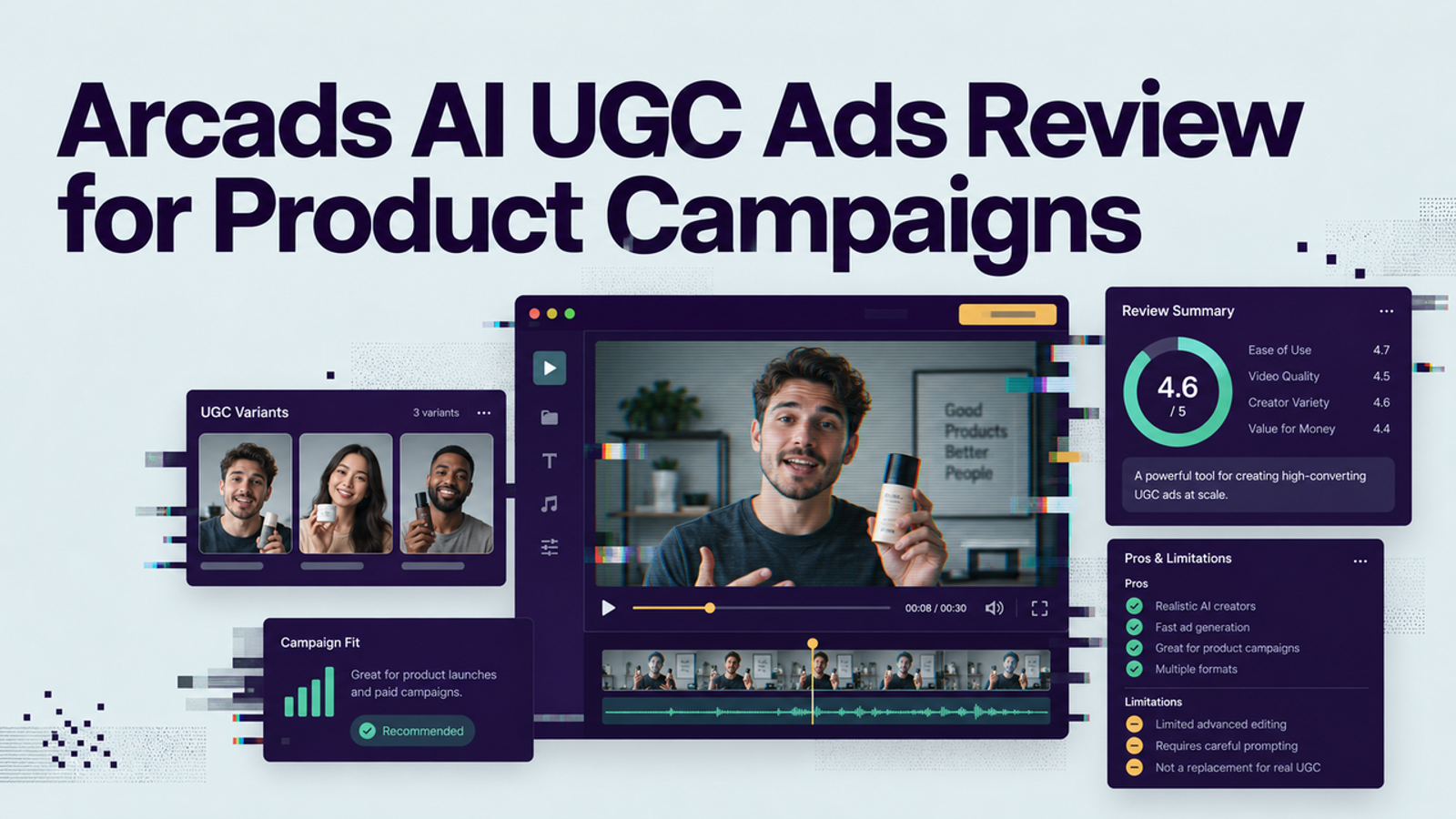
Arcads is the more focused first trial when a campaign needs direct-to-camera actor delivery and several creative variants. Its AI actor ad workflow starts with a script and actor, then lets a team show the product and add captions. That is a useful production route to evaluate, not evidence that a given actor will feel credible to your audience. “UGC-style” describes a visual approach; it does not turn a synthetic actor into a customer.
For skincare, a presenter may introduce the routine while real footage shows texture and application. For software, an actor may deliver the hook while the interface proves the feature. Choose based on the presenter’s job, then check product visibility and truthfulness.
How Can You Compare HeyGen and Arcads Fairly?
Use one approved product, one script, one claim, one placement, and one correction. Give both tools the same assets and review rules. Do not compare one finished edit with another tool’s raw render, or let one tool invent claims while the other follows locked copy.

Lock the Product, Script, Claim, and Placement
Use this brief as a starting template, replacing the bracketed fields with the brand’s approved information:
| Locked field | Trial specification |
| Product and evidence | One cleared SKU; approved pack shots; real demonstration footage for any physical claim |
| Script | “Meet [product]. It [verified benefit]. Here’s [proof shown on screen]. See [CTA].” |
| Placement | 15-second 9:16 paid-social video; name the channel, market, and export resolution |
| Captions | Same approved wording, mobile-safe placement, and required standalone file format |
| Revision | “Keep the opening and presenter; replace only the proof shot and fix the final caption.” |
The script is deliberately plain. Do not ask a synthetic presenter to say “I use this every day” unless that is a real, authorized testimonial from a person with that experience. A product claim needs evidence outside the actor’s delivery. If a feature depends on size, texture, an app screen, or a mechanism, supply the relevant real image or clip and judge that moment separately.
Review Presenter Delivery and Product Visibility
Have the same reviewer watch each export with sound, muted, and at normal phone size. Score whether the name and claim are pronounced correctly, the product appears when discussed, the label is readable, and captions match the approved script. Mark the timecode for each problem instead of writing “looks off.” Pretty is easy to spot. Useful takes another look.
Use a simple 100-point rubric, but apply three pass/fail gates first: usage rights are documented, the claim is approved, and the product shown is the correct SKU with no material mismatch. A rights or product-identity failure cannot be averaged away by a strong performance.
| Score after gates | Weight | Full-credit question |
| Presenter fit | 20 | Does the delivery suit the brand and keep attention on the message? |
| Product identity and proof | 25 | Does the correct product appear, and does real footage prove the claim? |
| Script and captions | 20 | Are spoken words and captions faithful to approved copy? |
| Revision isolation | 15 | Can the requested change be made without rebuilding approved sections? |
| Export and handoff | 20 | Does the client receive the required file, caption asset, permissions, and version record? |
For every score, keep a short reason and timecode. The scores help explain a choice; they do not predict click-through rate or ROAS. Those require a separate media test with controlled spend and audience conditions.

HeyGen for a Presenter-Led Product Explanation
Test HeyGen first when the presenter must explain what a product does, who it is for, or how a feature works. Keep the script fixed and judge pronunciation, emphasis, and pacing separately from the visuals. Put a real product shot where the script makes a promise. The presenter should frame the evidence, not replace it.
Before rendering, record the in-product estimate for the chosen presenter, product placement, resolution, and revision. A credit is a billing unit, not a comparable measure of video value across vendors.
For commercial use, separate plan eligibility from rights clearance. HeyGen’s terms permit commercial use of paid-plan outputs; Free-plan outputs are restricted to personal, non-commercial evaluation. The user remains responsible for uploaded material and output rights, so confirm the creating account’s terms.

Arcads for an Actor-Led Ad Variant
Trial Arcads when casting style, direct address, and actor variation are central to the brief. Start with one actor and the locked script. If that version passes the gates, change one variable—actor, hook, or delivery—on the next pass. Changing the actor and rewriting the copy together makes it hard to tell what affected the review.
If an actor holds the item, inspect the generated product image against approved packaging: proportions, hands, logo, and label at phone size. If the ad needs to prove a function, use real footage for that proof. Arcads’ current terms grant a non-exclusive video license that permits distribution and commercial marketing, but describe the license as personal and non-transferable; they also limit edits beyond listed changes unless approved in writing. Agencies should resolve client use and post-export editing in writing before the workflow is approved.

Compare Revisions, Approval Handoff, and Usable Cost
Keep two cost figures. Generation cost is the subscription allocation and credits for the initial render and paid changes. Usable ad cost is tool charges plus human review, editing, and required asset costs, divided by the number of ads that pass approval. Log charged failed attempts; if a refund rule is unclear, check the account rather than assuming the attempt was free.
Here is what the public meters tell you, checked October, 2026:
| Tool | Published reference | What the pilot still needs to capture |
| HeyGen | Creator is listed at $29 monthly with 600 credits; generation credits vary by feature and model | In-product estimate for the exact presenter route, product placement, resolution, and revision |
| Arcads | Talking-actor generation is 800 credits per started minute, per actor; a 15-second clip rounds up to one minute | Price shown for the account’s plan, plus any product-shot, gesture, caption, or revision credits |
Those balances are not a price comparison: the vendors meter different work, and Arcads pricing depends on the account’s offer. Allocate a dedicated subscription to its billing period; document a usage method for shared accounts.
Use one row per attempt: tool and model, duration, credits shown and deducted, reason for revision, reviewer minutes, editor minutes, export status, and final decision. The ledger should end with one approved output count. If 10 renders produce three approved ads, divide the attributable cost by three—not ten. The next edit is part of the cost.
Before handoff, approve the downloaded file, not just a preview. Save the final MP4, approved script, asset and likeness permissions, model/settings, caption file if required, and version ID in the client folder. Keep rejected drafts clearly marked so they cannot be mistaken for approved creative.

Which Tool Should Your Team Trial First?
For the arcads vs heygen decision, start with the campaign’s main constraint:
| Your brief’s main constraint | First trial | What could fail |
| A controlled explanation or presenter-led product walkthrough | HeyGen | Polished delivery takes attention away from the product proof |
| Creator-style actor performance or actor-led variants | Arcads | Product handling or claim language fails review |
| Product details or demonstration carry the argument | Product-led video workflow | A talking-head format may leave too little room for proof |
If the first two constraints are both important, run one matched clip in each tool before buying volume. Use the same reviewer, rubric, and correction. Select a route only after it passes the rights, claim, and SKU gates; visual preference alone is not an ad-performance result.
When Does a Product-Led Video Need a Different Workflow?
Use a product-led workflow when the item, interface, or real demonstration must carry the story. Narration alone cannot prove a physical feature. A route keeps the product as the visual subject, with a presenter as optional context. That is a different production route from the presenter- and actor-led comparison above, not a capability claim about HeyGen or Arcads.
Conclusion
In a heygen vs arcads decision, match the first trial to the brief: HeyGen for a controlled explanation, Arcads for actor-led variations. Judge the same product, script, placement, and correction against proof, rights, revisions, and delivery. Credits show generation use; approved outputs and the work to get them show ad cost. Run the matched pilot before committing spend.
FAQ
- Can a brand use the same AI actor in ads for competing products?
- The Arcads license described above is non-exclusive, so a generated clip does not itself grant category exclusivity. Check any actor-specific restriction and client contract, and avoid making one synthetic face appear to offer personal experience with competing products. A permitted actor is not automatically a truthful testimonial.
- Does a custom HeyGen avatar remain available after its owner leaves a team?
- Current HeyGen enterprise guidance lets a new Super Admin take over workspace control; avatar owners and Super Admins manage avatar access. It does not promise access after every member-removal or plan change. Before departure, assign another Super Admin, confirm avatar and voice access, and export needed files. Deleting the workspace removes its projects and assets.
- Can an agency move an approved actor clip between client accounts?
- An MP4 can be delivered, but that alone does not transfer the platform license. Arcads describes its video license as personal and non-transferable. If the agency created the clip under its own account, get written confirmation that the client relationship, downstream use, and planned edits are permitted before treating delivery as cleared.
- What rights are needed to use a synthetic presenter in a paid testimonial?
- Clear the likeness and voice, product assets, music, and the words being presented. Do not invent a customer’s experience or imply the synthetic actor used the product. The FTC’s testimonial guidance does not categorically prohibit AI avatars, but fake or deceptive underlying testimonials can still create risk. Check the applicable market and platform requirements with the responsible reviewer.
- Can either platform supply separate caption files for a client's accessibility review?
- HeyGen’s export guide documents downloading captions as an SRT file. Arcads’ public UGC workflow describes styled captions added to the video, but the documentation reviewed does not list a separate subtitle-file export. If the client needs a standalone file, make it a trial gate and confirm the current account workflow before production; An overlay is not a substitute.