
The short answer
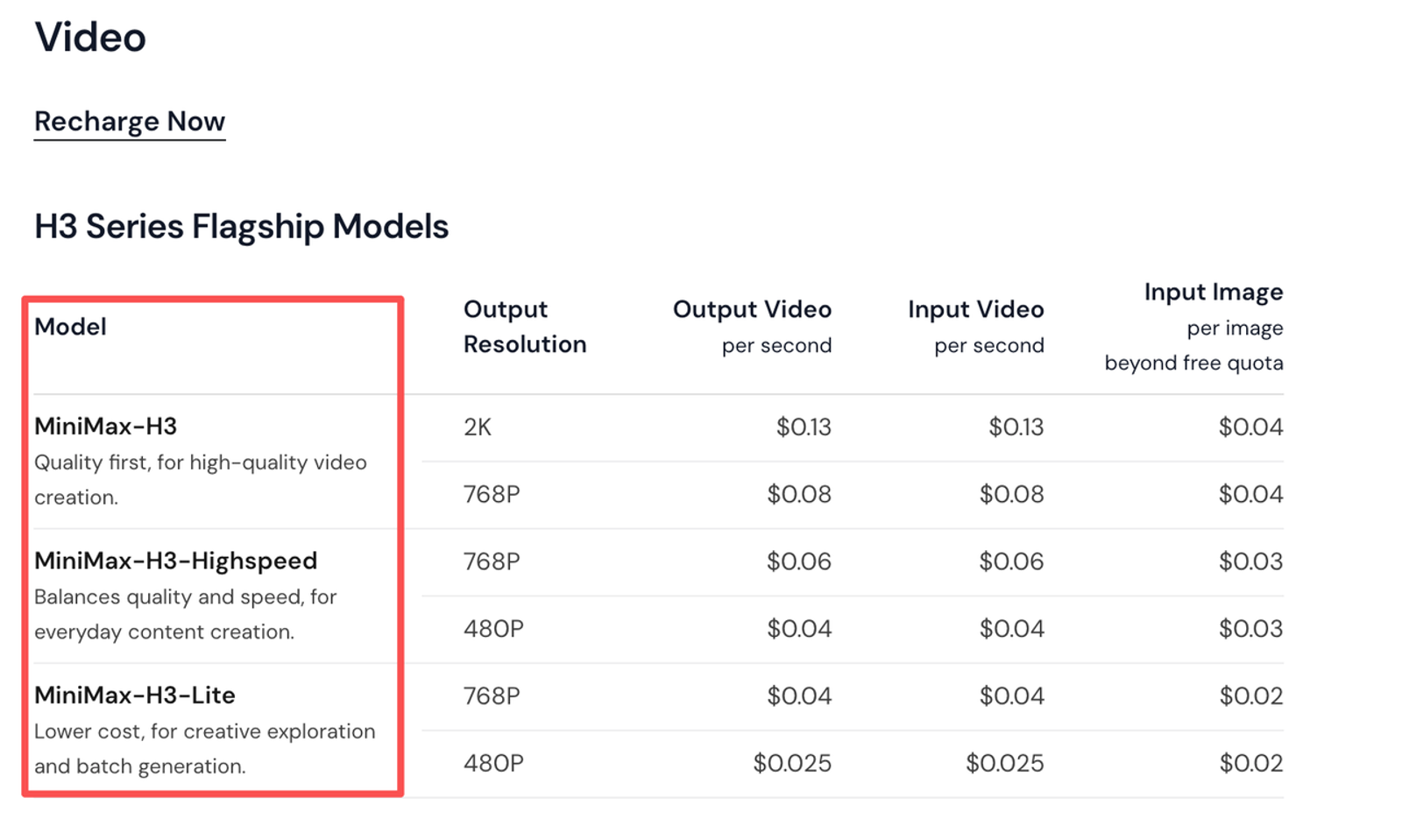
MiniMax H3’s pay-as-you-go video API lists US$0.08 per generated second at 768P and US$0.13 at 2K. A six-second product clip made from one image and no input video costs US$0.48 at 768P or US$0.78 at 2K under the published rates. The budget for an approved shot also needs to cover completed drafts, billable references, and review time.
The figures below use MiniMax’s US-dollar rates for the MiniMax-H3 video model, checked on November 11, 2026. They are planning estimates calculated from the official MiniMax API pricing table.
Where Is MiniMax H3 Pricing Published?
MiniMax lists generated video, input video, and billable input images separately. It also publishes distinct rates for H3 Highspeed, Lite, and Max. At 768P, for example, H3 and H3 Max both list US$0.08 per output second, but their input-video rates are US$0.08 and US$0.143 per second, respectively. That difference matters when a product shot uses a motion reference. The 4K H3-Image promotion on the same pricing page applies to still-image requests.
The current API pricing overview presents pay-as-you-go billing and Audio Packages. For an H3 video estimate, use the listed pay-as-you-go rates unless your account or contract specifies a different arrangement.
API Rates Versus Third-Party App Credits
Third-party apps set their own credit deductions. To compare an app quote with the API, price the same model variant, output resolution, clip length, and input assets on both routes. A six-second clip that uses a single packshot can have a different cost from a six-second clip that also uses a motion reference, even when the delivered files have the same resolution.
What Changes the Cost of One Product Clip?
Duration, Resolution, and Input Materials
Output duration and resolution set the base charge. For standard H3, the first five input images per task carry no image fee, and each additional image costs US$0.04. Input audio is free. Input video is billed by its own duration at the rate for the chosen output resolution. The H3 video generation guide lists whole-second outputs from 4 to 15 seconds at 768P or 2K.
For a six-second 768P shot, one approved packshot adds no image charge. Add a six-second video reference and the input charge is US$0.48, bringing the listed total to US$0.96. I would budget for that reference when the camera move is specific enough to judge against it. If the first review is only about framing and timing, the packshot alone may be enough to start.
A Worked Estimate From the Current Rate Table
The table uses a six-second output, one input image, and a six-second video reference where specified. All amounts are in USD.
| Route | With one image | With one image and a six-second video reference |
| Direct 768P | $0.48 | $0.48 output + $0.48 input = $0.96 |
| Direct 2K | $0.78 | $0.78 output + $0.78 input = $1.56 |
| 768P draft, then eligible 2K regeneration | $0.48 + $0.30 = $0.78 | $0.96 original task + $0.60 regeneration = $1.56 |
Regeneration costs US$0.05 per output second. MiniMax bills the original input materials again at regeneration rates: US$0.05 per original input-video second and US$0.025 per image beyond the first five. Input audio remains free. The two routes in the table have the same listed total for a single selected take under these assumptions. The budget difference comes from deciding how many drafts to finish at 2K.
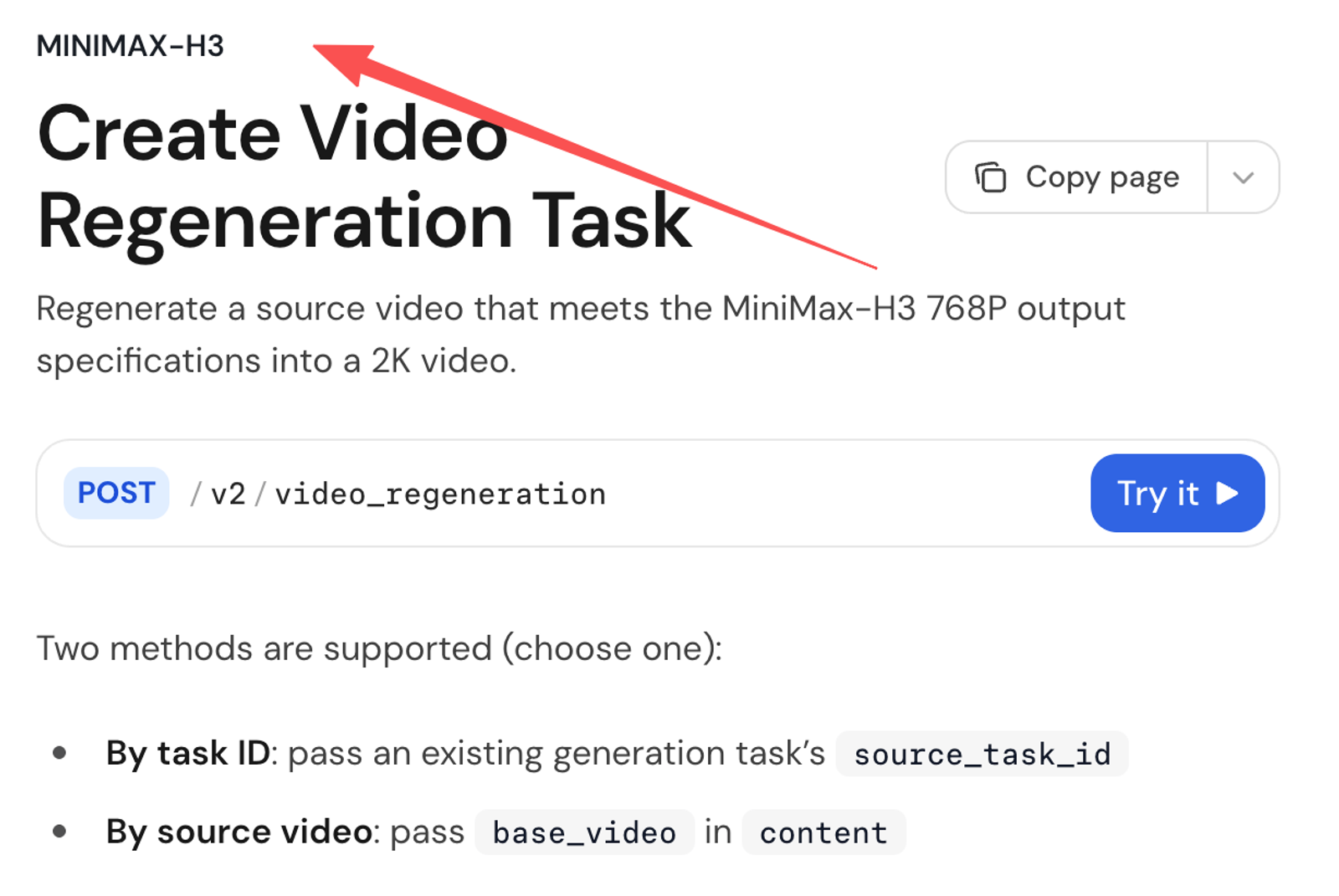
Before relying on that route, confirm your account can use it. Regeneration requires a source that meets H3’s 768P output specifications. If you submit by task ID, MiniMax requires approved account access and a successful source task owned by that account that is still queryable within seven days. See the H3 video regeneration API reference.
How Should a Team Budget for Approved Video?
Drafts, Revisions, and Review Rejections
Count completed drafts that the brand rejects as production spend. A task can succeed while changing the label, missing the camera move, or leaving too little room for ad copy. Track the task ID, model, resolution, duration, input assets, and charge shown in the account. Record the rejection reason beside each clip so the team knows what to change before paying for another attempt.
The next edit is part of the cost. If the logo drifts halfway through a shot, the team can compare the cost of another generation with the time needed to composite approved artwork. A clear rejection reason makes that decision easier to budget.
A Budget Range for a Small Campaign Test
Suppose the team needs two approved six-second shots. Allowing six to ten completed 768P drafts costs US$2.88–US$4.80 at list price. Regenerating two eligible selected takes at 2K adds US$0.60, bringing the estimated API total to US$3.48–US$5.40. If every draft needs to be reviewed at 2K, six to ten direct generations cost US$4.68–US$7.80.
Both scenarios assume one image per task and no input video. The draft count is a spending allowance. Actual approvals depend on the footage, the brief, and the review criteria. Editor time, taxes, and account-specific pricing sit outside these estimates.

When Is H3 a Sensible Budget Choice?
Match the Model Bill to the Full Production Task
H3 is worth budgeting for when a short shot can be reviewed against an approved packshot before the team spends time finishing it. A 768P draft may be sufficient for judging camera timing and composition. If the client needs to read small packaging text, include a 2K check before signing off.
Shots that need to show an unseen side of the package, reproduce fine print exactly, or demonstrate a specific product action deserve a different estimate. Photography, 3D, or compositing may cost more upfront and give the team direct control over those details.
Conclusion
A six-second MiniMax-H3 clip from one image lists at US$0.48 at 768P or US$0.78 at 2K. A production estimate should show how many completed drafts the team can afford, which references will be billed, and which takes may need regeneration. Add editing and review time to see what the team is spending per approved shot.
FAQ
- Does MiniMax offer H3 API volume discounts?
- The public H3 pricing table gives list rates and does not specify standard volume tiers. Use a negotiated rate in a forecast once MiniMax confirms the eligible model, usage, and contract term in writing.
- Are failed MiniMax H3 generations charged?
- The current public documentation reviewed does not establish a billing rule for every failed H3 pay-as-you-go task. For a failed task, check the task ID against the usage record and ask MiniMax to confirm any unclear charge. Track completed clips rejected during creative review as completed attempts in the production budget.
- Do MiniMax H3 API credits expire?
- Check which balance or entitlement you hold. MiniMax says resource packages, vouchers, and other entitlements may have validity periods specified on their purchase or service pages. The applicable terms are in the MiniMax Open Platform Paid Services Agreement.
- Can a business receive an invoice for H3 API usage?
- MiniMax documents online payment and bank transfers for account funding. Its public FAQ leaves the invoice available to a particular business account unconfirmed. Finance can verify the billing entity, invoice format, and required company details using the MiniMax account FAQ as a starting point.
- Do MiniMax H3 rates differ by region or tax treatment?
- The public API table quotes US dollars. For a purchase order, use the billing country and the tax and fee amounts shown at checkout or specified in the contract. Please refer to the latest official documentation for the applicable charge.