Product video ads get expensive in two ways when every “new version” changes five things at once: you spend more on production, and you lose the chance to learn what actually changed the result.
I’m Vela, and I care less about how many variations a team can generate than whether each variation answers a useful campaign question. My rule is simple: choose the job, lock the product proof, change one meaningful variable, and keep enough history to understand what happened afterward.
Update note: Platform guidance referenced below was checked against official sources in October 2026. AI labeling and advertising policies are still changing quickly, so I would recheck the relevant platform before launching synthetic-media or regulated-category campaigns.
Start With the Campaign Decision
Before choosing a format, decide what the ad needs to help you learn.
A prospecting ad may need to make an unfamiliar problem, product category, or outcome understandable quickly. A retargeting ad can move closer to the buying decision by resolving hesitation around a feature, use case, offer, or piece of evidence.
Those are different jobs. Treating them as interchangeable makes creative testing harder to read.
Separate Prospecting From Retargeting Jobs
For prospecting, I would ask a basic question: can someone who does not know the brand understand why this product deserves another few seconds of attention?
That does not mean every cold-audience ad needs a dramatic problem statement. Sometimes the fastest explanation is simply seeing the product work.
For retargeting, I would look for the unanswered question. Maybe people saw the product but did not understand how it works. Maybe price is the sticking point. Maybe they need to see a particular feature, product angle, or use case before making a decision. The campaign stage changes what deserves emphasis. It does not change the standard for truthfulness.
Define the Product Proof Behind the Ad
Before writing hooks, write down what the ad can actually prove.
A storage product can show what fits inside it. A cleaning tool can show how it moves across an appropriate surface. Software can show a real interface state or workflow. A physical product can show size, assembly, texture, or a mechanism if the video represents those details accurately.
This is where AI-generated product video needs extra review. A generated scene can make a product look waterproof, faster, larger, more durable, or more effective without anyone deliberately writing that claim. The image itself can communicate it.
That matters because advertisers are responsible for both express and reasonably implied objective claims. FTC guidance says advertisers should have a reasonable basis for objective claims before an ad runs. The FTC advertising substantiation guidance is a useful starting point when a video makes measurable product claims.
So I would treat product preservation as part of claim review, not just visual quality control.
Choose a Product Video Ad Format by the Proof You Need
I would not start with “Should this be UGC?” or “Should we make it cinematic?”Start with the buying question. Then choose the format that makes the answer easiest to see.
Demonstration Ads Show the Product Working
A demonstration ad is useful when product behavior itself answers an objection.
Show the action early. Keep the sequence readable. Give the viewer enough time to see what changed rather than hiding the important moment under fast cuts, captions, and camera movement. I would also build for the placement instead of creating one master file and assuming every crop will behave the same way.
For Reels, Meta currently recommends native vertical creative with audio and important messages inside the safe zone. Meta also supports placement-level creative customization rather than assuming one asset should simply be cropped everywhere. Its current Reels creative guidance is worth checking before export because interface overlays can affect what remains visible. The practical takeaway is not “always use one exact format.” It is simpler: preview the actual placement.
Check whether the product, subtitles, price, disclaimer, and CTA still survive the interface around them.
UGC-Style Ads Need an Honest Speaker Role
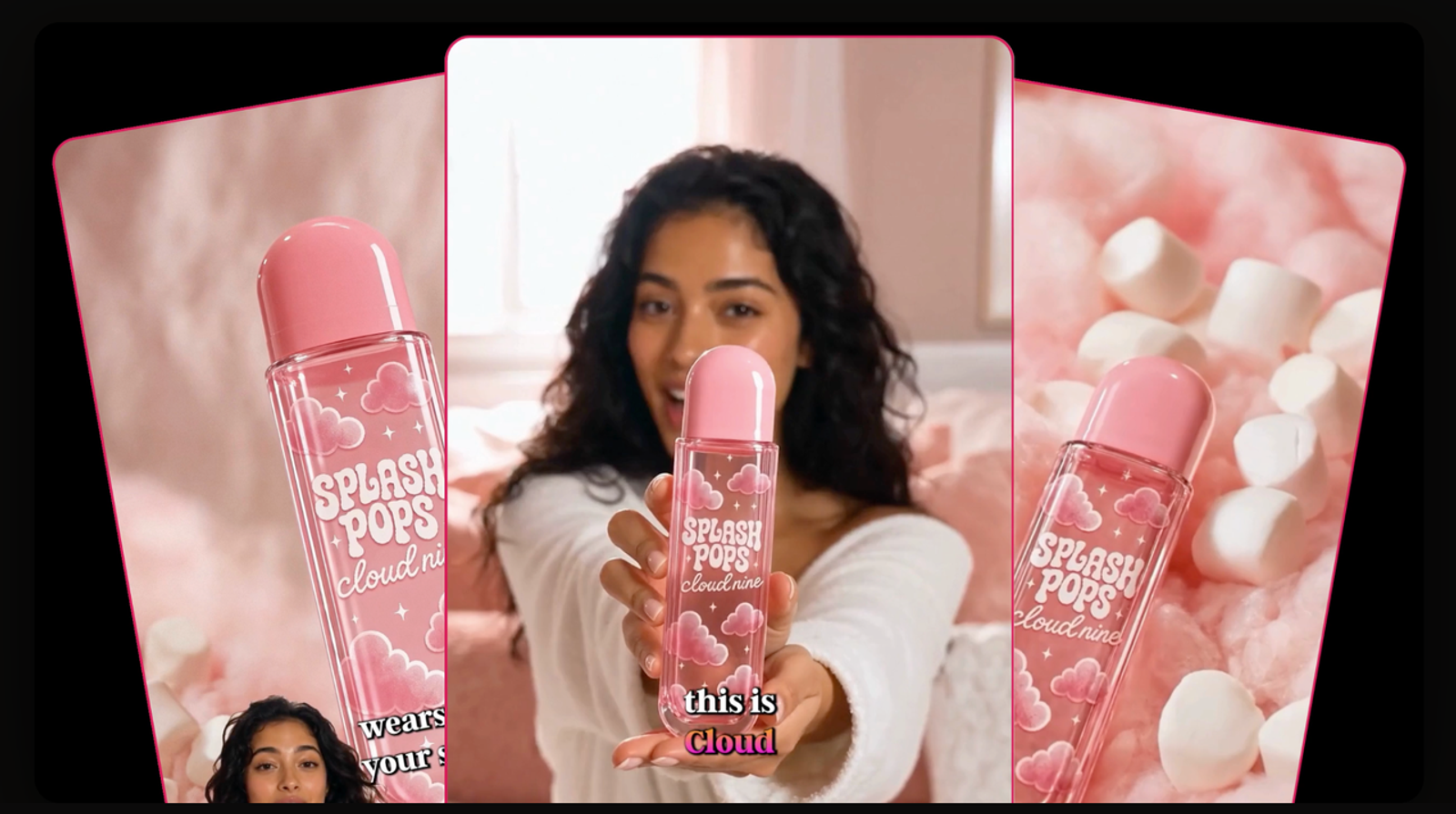
UGC-style product video works well when a speaker helps a viewer recognize a problem, understand a use case, or hear an objection answered in conversational language.
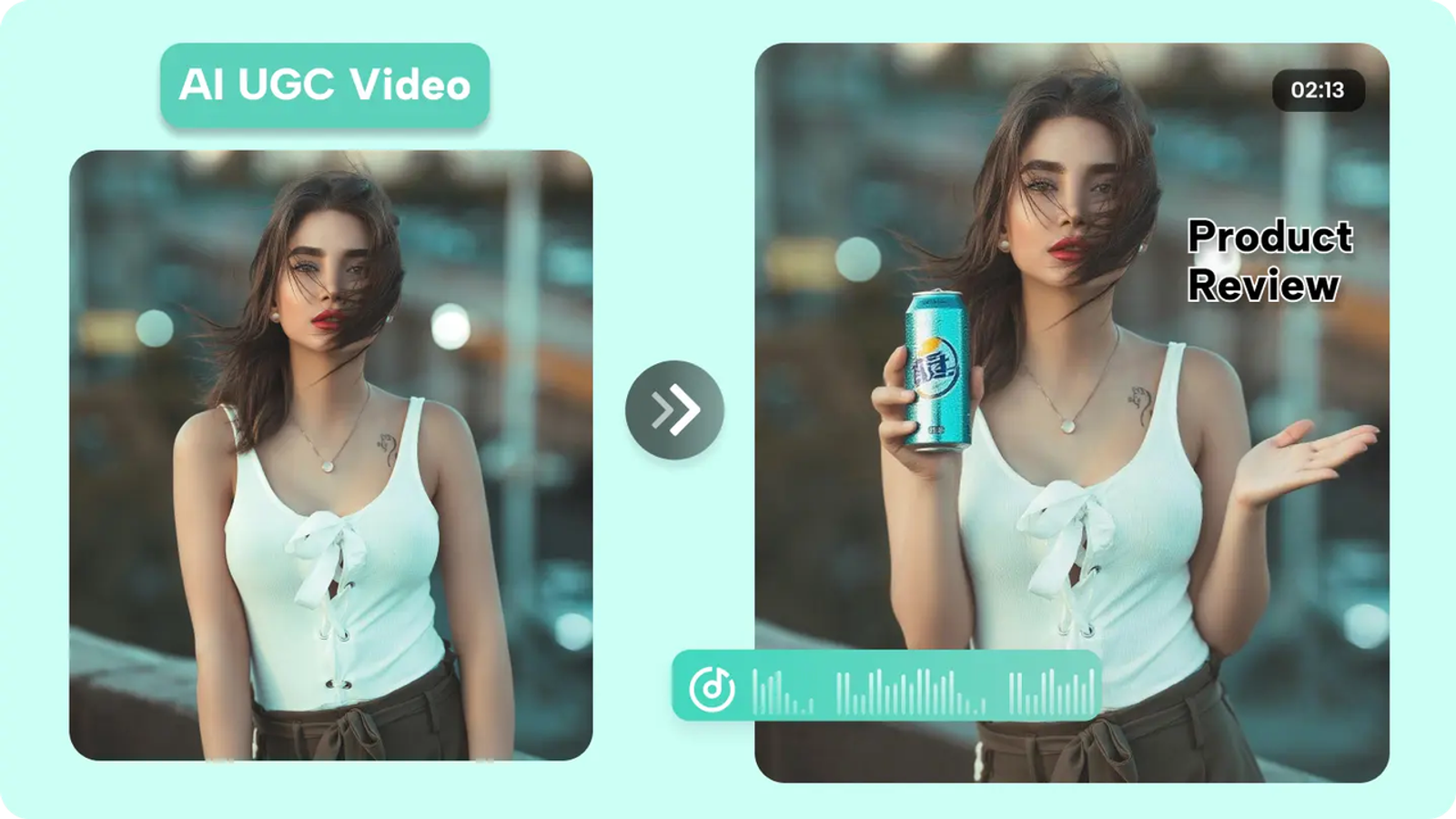
The risky part is confusing the style of a testimonial with evidence that a testimonial really occurred. That distinction matters more now that synthetic presenters are easy to create.
The FTC’s current Consumer Reviews and Testimonials Rule does not impose a blanket ban on AI stock avatars. But an AI avatar can still become deceptive if it presents a fake or false underlying testimonial, and other endorsement rules can still apply. The FTC guidance on reviews and testimonials explains that distinction.So if I did not have real customer experience behind the script, I would not write the synthetic presenter as though they personally bought, used, loved, or benefited from the product.
Use the avatar as a spokesperson, demonstration host, or clearly fictional scenario instead. That still gives you the conversational structure of UGC without manufacturing a customer.
Visual Story Ads Build Context Around Use
Not every product needs to be explained like a laboratory demonstration.
A travel organizer might move from scattered packing to a finished suitcase. A lamp might show how a desk or reading corner feels before and after it is switched on. A kitchen product may be easier to understand inside an ordinary preparation sequence.
These ads can build desire through context. But context is not proof. A prettier room does not prove productivity. A fitness montage does not prove a health outcome. A clean visual transformation does not automatically prove that the product caused everything the viewer sees.
If the story communicates a measurable product result, I would ask whether the evidence supports that interpretation before generating more variants.
Build Hooks Around Testable Hypotheses
A hook becomes useful for testing when you can explain what changed.
“Problem-first versus product-first” gives you a question.
“Make three completely different videos and see which wins” may give you three performance numbers, but much less understanding.
Change One Meaningful Opening Variable
If you want to test the opening, keep as much of the rest of the ad stable as the production allows.
That may mean holding the product, offer, proof sequence, CTA, audience, and destination page constant while changing one element. One version might begin with the problem. Another might begin with the product already in action. Now the test has a clear question: does problem-first or product-first create the stronger response for this campaign?In practice, perfect isolation is not always possible.
A new first shot can slightly change pacing, duration, or audio timing.
That is fine.The goal is not laboratory purity. The goal is to avoid changing so much that the result becomes difficult to interpret.
Keep the Offer and Evidence Consistent
Suppose Hook A opens with “20% off today,” while Hook B opens with the product solving a problem.
That is not just a hook test. One ad introduces an offer that the other does not. The same issue appears when one variation gets stronger product proof, a different price, a more credible speaker, or a different landing page.
Before publishing a test, I like to finish this sentence:“The thing we are trying to learn is whether ______ changes ______.”
If I couldn't fill that in without listing four variables, I would simplify the test.
Put AI Disclosure in Launch QA, Not in Your Memory
AI disclosure rules have become too specific to rely on “I think this platform labels it automatically.” As of October 2026, the major platforms do not handle disclosure in exactly the same way.
Meta updated its ads transparency system in 2026, folding AI-related information into the About this ad experience and expanding its use of technical signals for content created or modified with third-party AI tools. Meta’s generative AI advertising transparency update explains how those disclosures are evolving.
TikTok’s advertising policy requires disclosure for ads containing media that is completely AI-generated or significantly modified by AI. Its guidance distinguishes those changes from minor edits such as basic lighting, color, or denoising adjustments. I would check TikTok’s current misleading and false content advertising policy before launch.
Google also introduced additional AI-label controls for advertisers in 2026. Advertisers can add AI labels to supported generated or modified creatives, and Google may automatically label some assets created with its own AI tools. Google also makes clear that using its labeling tools does not guarantee compliance with local law. Its AI-generated content labeling guidance is worth reviewing as part of launch QA.
I would therefore add one question to every campaign checklist:
Was this asset generated or materially altered with AI, and what disclosure does this placement and market require?
That is safer than deciding based on whether the creative “looks AI-generated.”
Assemble a Controlled Creative Matrix Without Overcomplicating It
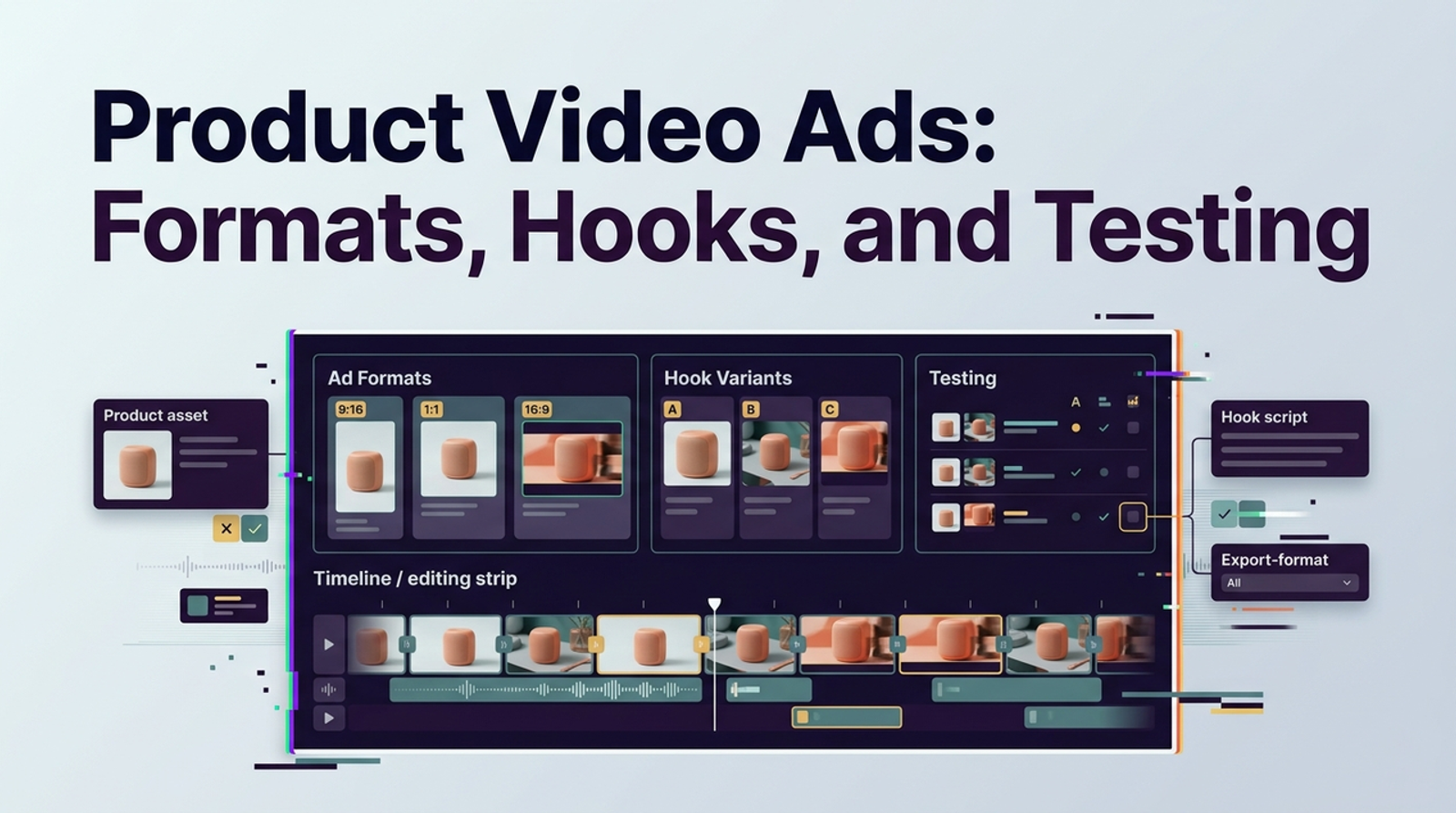
A useful creative matrix does not need fifty variations. I would start with the smallest test that can answer one useful question, then add another variable only after the first comparison tells me something.
For example, if I want to test the opening, I might create two versions of the same ad. One starts with the problem; The other shows the product first.The proof sequence, offer, CTA, audience, and destination page stay the same. The question is simple: does problem-first or product-first create a stronger response for this campaign?
Once I have an answer—or, at least a useful signal—I, I can move to the CTA. I might keep the winning hook and product demonstration unchanged, then compare two next steps: one asking the viewer to shop now, another inviting them to learn more.
At that point, I am testing the requested action rather than accidentally testing a completely different ad.
Product proof can be tested the same way. If one version shows the mechanism immediately and another delays it until after the setup, I can ask whether earlier evidence helps the viewer understand the product and continue to the next step.
That gives me three separate questions.
Opening: Does problem-first perform differently from product-first?
CTA: Does changing the requested next action affect response?
Proof timing: Does showing how the product works earlier improve the next step?
I would not test all three at once.
Two hooks, one proof sequence, and two CTAs already create four possible combinations. That is enough for an early round without turning the campaign into a pile of versions nobody can explain later.
Actors, locations, music, offers, scripts, camera styles, and landing pages can all become useful variables.
They become a problem when they are added before the previous question has been answered.
The simplest check is this:If I cannot explain in one sentence what changed and what I am trying to learn, the test probably has too many moving parts.

Preserve Naming and Version History
“final_v7_REALfinal.mp4” is funny until you need to work out why it performed differently three weeks later.
I would use a name that records the variables instead, such as:P1_problemhook_demo_ctaA
Then I would keep the source asset, generation or export date, platform, aspect ratio, hook, proof sequence, CTA, and meaningful revision notes attached to that version.
This matters even more with generative video because one requested edit can quietly change something else.
You may ask the tool to change the first shot and get a slightly different package shape, background, presenter, product label, or camera angle at the same time.I think of this as regeneration drift.
If that happens, I would not pretend the new output is still a clean hook test.Either regenerate until the important evidence stays consistent or record it as a genuinely different creative version.
The point of version history is not administrative neatness. It is what lets the next campaign learn from the previous one instead of starting from zero.
Read Results at the Level of the Question
A winning ad is not automatically a new creative law.If the only controlled change was the opening, the result tells you something about that opening in that campaign context.It does not prove that problem-first hooks are always better, that the speaker should appear in every future ad, or that the format works for every audience.
I would also look downstream.An opening can improve early attention while attracting the wrong expectation. A high click response can still lead to weak product-page behavior.
A stronger CTA can generate more actions while reducing their quality.When those signals disagree, do not immediately make the hook louder.Check whether the promise, product proof, offer, and next step still match.
Keep the strongest current version as a control, then branch from the next unanswered question.That is the part of product video testing I find most useful.The output is not just another ad. It is a slightly better idea of what to test next.
Final Takeaway
Good product video testing is less about producing more ads and more about preserving meaning between versions.
Start with one campaign question. Decide what the product can honestly prove. Choose a format that makes that proof easy to understand. Change one meaningful variable, keep the rest stable enough to interpret, and record what happened.
AI can make variation much faster. It can also make uncontrolled variation much easier.That is why I would not judge an AI product-ad workflow by how quickly it gives me ten exports. I would judge it by whether I can tell why version eleven should exist.