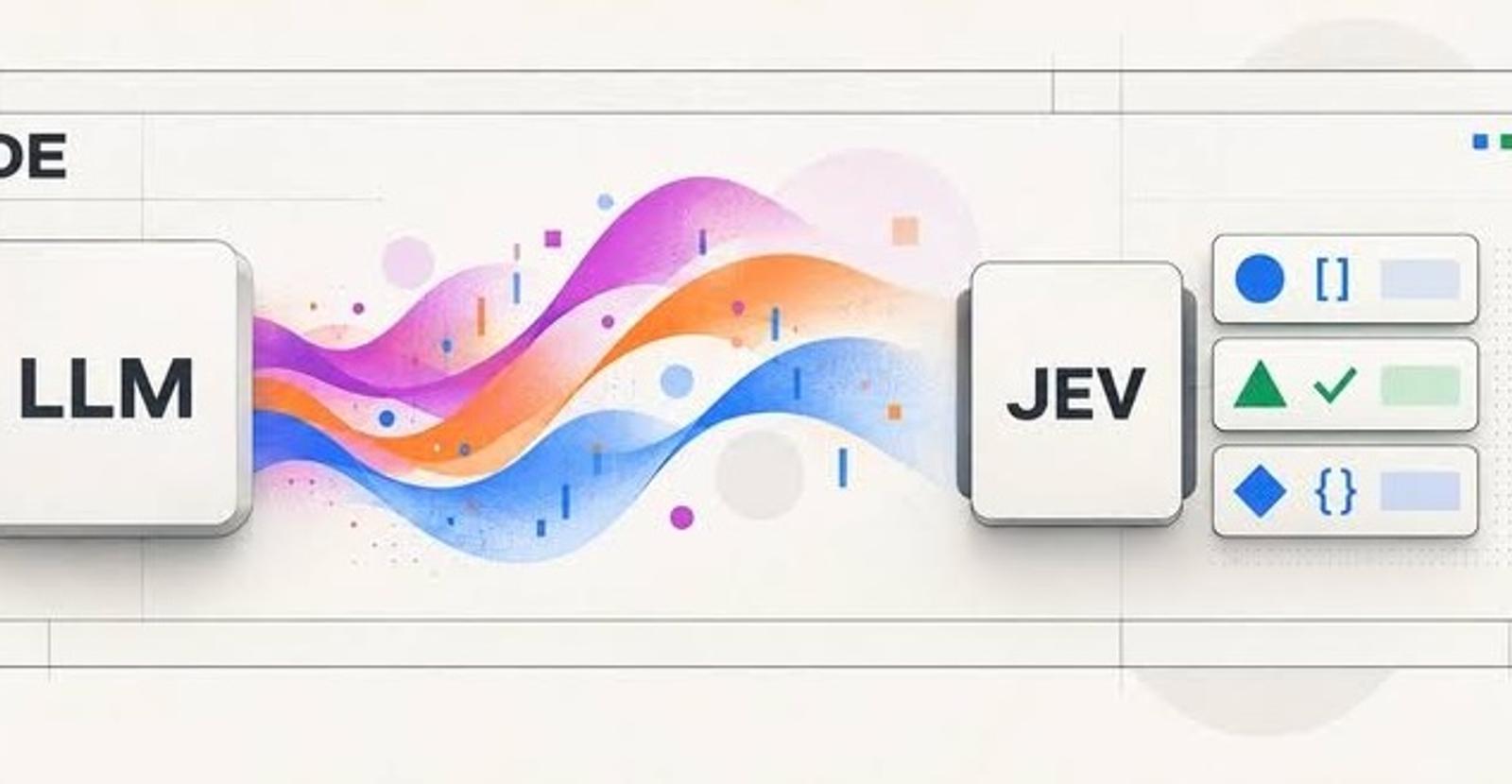
TypeSafe AI helps ads, creative, and content teams judge work, not generate it. Jev, the company’s first System One model, returns typed decisions so software can route a variant, block a claim, or send a row to a human. It does not write the ad, draw the still, or render the clip.
I pulled United States Keyword Planner data on 21 September 2026. `typesafe ai` sat in the 100 to 1,000 monthly band, with a 900 percent year-over-year jump, low competition, and top-of-page bids from $4.66 to $26.53. That spike is awareness, not proof that the model makes creative. The docs still describe evaluation.
If you came here hoping the company would replace a generator, stop. Keep a generator for assets. Keep Jev for the checklist that used to live in a spreadsheet. I already wrote the capability check in can the Jev model generate video or images.
What can TypeSafe AI do for ads
The Advertising row in TypeSafe’s use-case map is the cleanest answer I have. It lists four jobs: evaluate creative assets, campaign copy, landing pages, and placement context; classify brand safety and audience suitability; check regulatory compliance and prohibited claims; evaluate creative quality and ad-to-landing-page alignment.
Those are review questions. They map onto Choice, Score, and Noul. I would ask whether a voiceover matches an allowed claim, whether a thumbnail is brand-safe, and how well a landing page continues the ad. Code can then keep, hold, or kill the variant.
TypeSafe’s 15 September 2026 launch post frames the same idea as smart if-statements inside ordinary software. Jev is not a copywriter sitting in the ads account.
I already keep a human pass on claims when I test AI UGC ads. Jev is a faster version of that pass, with a probability attached. It is not a replacement for the FTC rule that claims must be truthful, not deceptive, and evidence-based.
Can TypeSafe AI write creative or content
No. The System One introduction says large language models produce text for humans, while Jev returns structured results with no text generation and no parsing. The System One page adds that these models do not write replies, produce code, or generate explanations.
So Jev will not draft a hook, a caption, or a 15 second script. It will not layout a carousel. It will not localize a page. If you need those strings, use a writing model or a person. If you need a decision on a string you already have, use the System One API.
I checked adjacent Planner seeds the same day. `typesafe jev` and `jev typesafe` were 0 to 10. `typesafe ai video` returned no metrics. People are learning the brand name. They are not yet searching a video product, because there is not one.
When I need the asset itself, I still open a generator. Social stills go through a flow like GPT Image 2.5 for social media ads. Product clips go through how to make a product demo video with AI. The review model sits after those tools, on the desk.
How would I score a campaign with Jev
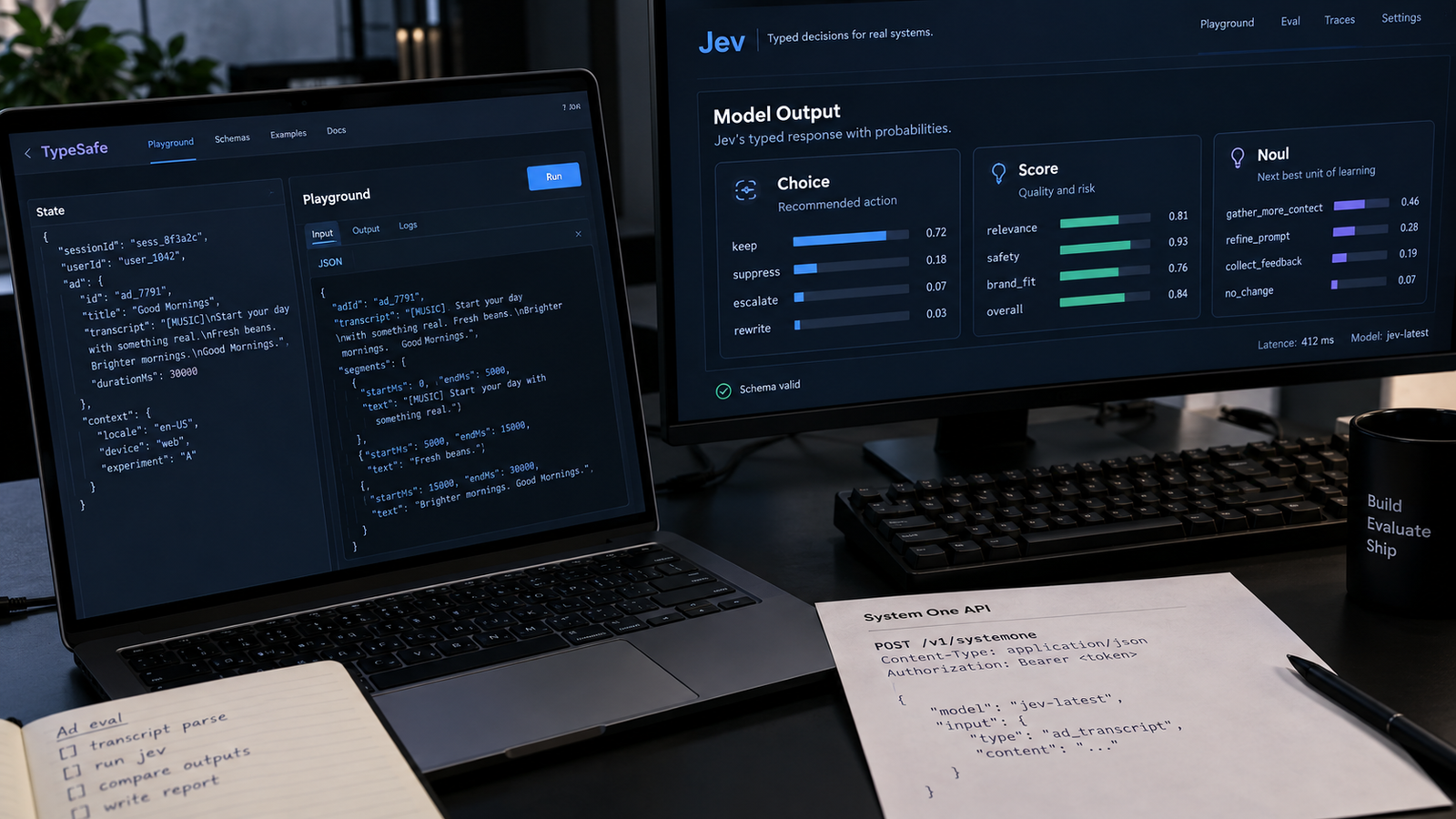
I freeze the state first. One campaign, one audience, one allowed claim, the ad copy, overlay text, a transcript if the asset is video, and the landing-page hero. Then I ask independent questions in one request, because TypeSafe evaluates questions in parallel against the same state.
A set I would actually ship:
- Noul. Does the ad state a health, finance, or performance result that the landing page does not support?
- Choice. Which next action: keep, revise copy, revise visual, or hold for legal.
- Score. How well does the first three seconds match the brief, on a rubric I wrote down before I generated anything.
I do not let Jev invent the rubric. The docs are clear that you define possible answers in advance. Changing a weight later should be a code change, not a new prompt.
TypeSafe quotes 70 ms to 500 ms for System One shaped queries and $0.042 per million input tokens. That is why this review can sit in a loop that scores hundreds of variants. It is also why I still escalate low-confidence rows. Calibration across a batch is not a guarantee on one ad.
For the render that feeds this loop, I use the Wizstar AI video generator. Jev never sees the pixels. It sees the text I extract from them.
When should you still generate the asset
Always, if the job is a still, a clip, or a page. This stack does not remove that step. It only makes the step after it cheaper to repeat.
I generate three variants, change one variable, and stop if identity fails. Then I send Jev the brief and the text. If two variants clear both the visual sheet and the typed review, the generator earned the next brief. If they fail the claim check, I do not generate ten more. I change the copy.
That split is the whole point of this search this week. `typesafe ai` is a brand query with a 900 percent jump. The page that should rank for it is a capability page, not a fake generator page. Use TypeSafe AI to judge creative, ads, and content. Use a generator to make them.
FAQ
- Does TypeSafe AI generate video or images
- No. Jev accepts text only. Images, audio, and video are not supported yet. Generate the asset in a media model, then send Jev the brief and extracted text.
- Can Jev replace a copywriter on ads
- No. It does not write replies. It can score a line you already wrote against a claim list. A person or a writing model still has to produce the line.
- Where should Jev sit in a content workflow
- After generation, before spend. I use it to classify brand safety, check prohibited claims, and route low-confidence rows to review. I do not use it to invent the first draft.